Product Knowledge

Product Knowledge

Search
Product Knowledge
Thank you! Your submission has been received!
Oops! Something went wrong while submitting the form.
Product Knowledge
Honey for Recovery and Rehydration: A Product Opportunity
Register for wholesale access at honey-x.au to view batch certificates and pricing. Independently tested WA active honey for wholesale and export buyers. Register at honey-x.au for batch certificates and pricing.
Honey X
Apr 4, 2026
April 4, 2026 16:58
1 min read

The Market Case for Honey in Recovery and Rehydration Products

Product developers in active wellness and adjacent categories are moving away from synthetic ingredient lists toward natural ingredients with documented bioactive properties, a clean-label story, and verifiable supply chains.

Honey sits at the intersection of all three requirements. What makes it commercially relevant is not just the category positioning. It is the documented properties of specific honey varieties, and what those properties mean for product formulation at a technical level.

This post covers what the research indicates, which honey varieties are relevant to this product category, and how private label formulation through Honey X gives brand builders access to both the supply and the development capability to bring a credible product to market.

What the Research Indicates

Honey has been the subject of considerable research interest in the context of carbohydrate delivery and physical performance. The University of Memphis conducted a 64km cycling trial in which honey was found to perform comparably to synthetic carbohydrate gels as a fuel source across the duration of the event.

The carbohydrate profile of honey is a key reason for this. Honey is approximately 80% carbohydrates, composed of roughly 35 to 40% fructose and 30 to 35% glucose. This profile is relevant to product developers building in categories where carbohydrate delivery and dose are central formulation considerations.

Dose also matters. Research indicates that a 60g dose delivers a more meaningful response than a 30g dose. For sachet format decisions, this is a directly applicable data point. The 30g sachet format available through Honey X aligns with the higher end of the dose range indicated in the literature.

On the rehydration side, a study on Acacia honey found that participants who consumed honey before a second run covered approximately 10% farther compared to those who consumed water alone. This is a documented observation about performance across a second exercise bout. It is the kind of data point that product developers in this category need to understand when evaluating honey as a natural ingredient.

Why WA Honey Varieties Are Relevant to This Category

Not all honey is equivalent from a formulation standpoint. The bioactive compound profile varies significantly by botanical source, geography, and production method.

WA honey is produced in one of the world's most biosecure beekeeping environments. Over 80% of WA's honey-producing forests remain untouched by development. Beekeeping in WA is conducted without antibiotics, chemical treatments, or artificial feeding. This matters to product developers because it means the bioactive compound profile of the raw material is consistent and uncontaminated across supply.

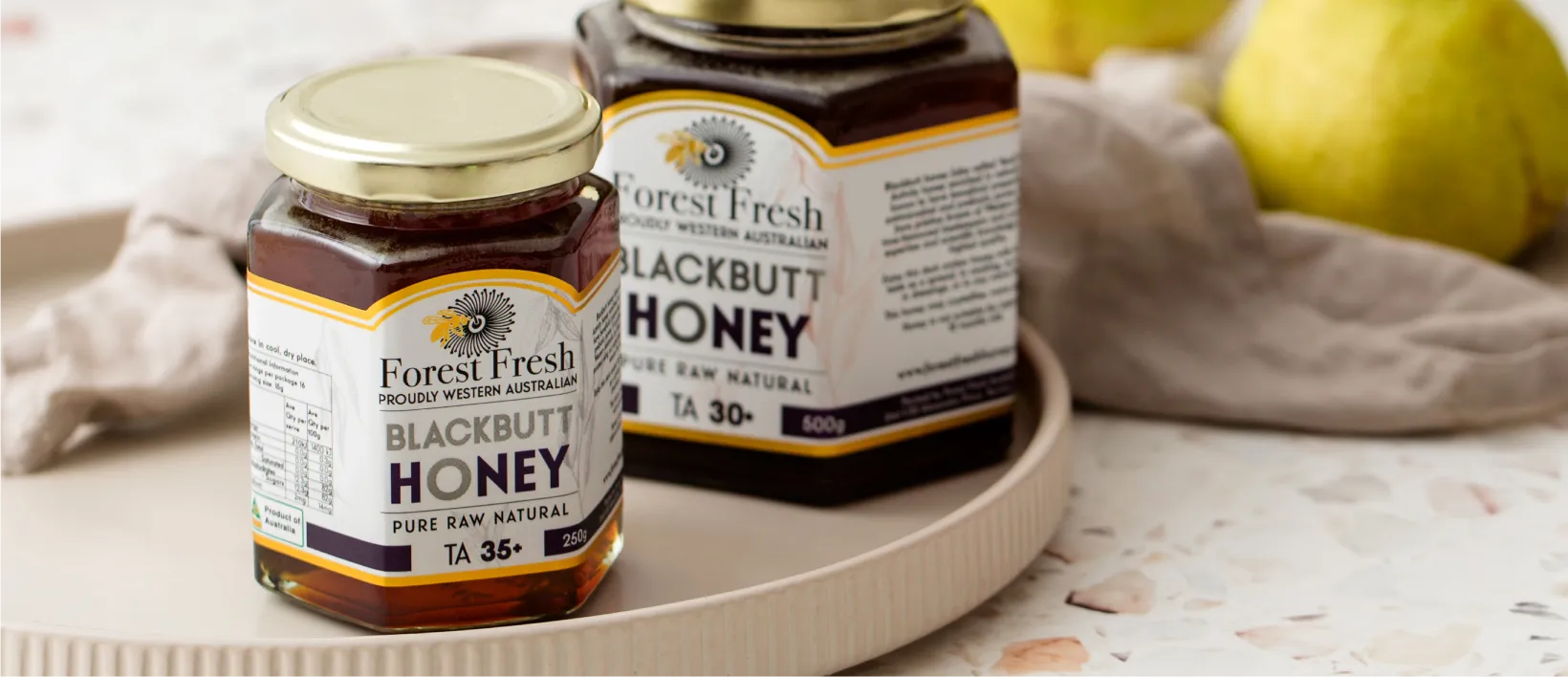
Western Australian honey varieties, particularly Jarrah and Yarri (Blackbutt), carry meaningful polyphenol and flavonoid concentrations that have been verified through third-party testing. Yarri (Eucalyptus patens) is notably rich in antioxidant and antibacterial compounds. Jarrah (Eucalyptus marginata) carries high Non-Peroxide Activity alongside a documented antioxidant profile.

These are not marketing assertions. Honey X products are tested and third-party verified at Analytica (ALS), ChemCentre, and the University of Sydney. The 153+ third-party tests conducted across five independent laboratories provide the kind of documented evidence base that brand builders in regulated and semi-regulated product categories need to reference.

Jarrah Honey: The Low GI Base

Jarrah honey carries a low glycaemic index of 46, independently trialled and validated under the Glycemic Factor™ for the Jarrah TA50+ grade. This is a clinically trialled figure, not a category estimate. For product categories where GI positioning is commercially relevant, this is a formulation-level advantage with documented evidence behind it.

Jarrah's low GI is a product of its natural sugar composition. Its high fructose to glucose ratio results in slower glucose release, and it is the same compositional feature that prevents crystallisation, underpinning the Crystallisation-Free Guarantee™. For infused product development, a base that does not crystallise and carries a clinically trialled GI of 46 is a meaningful formulation asset.

Jarrah is available in grades from TA15 through TA55+, all independently tested under the Well-Diffusion Phenol Equivalent (WDPE) methodology. Read more on how WA honey performs as a performance ingredient in published data.

Sachet Format: The Right Delivery Format for This Category

Product format is as important as ingredient selection. Single-serve delivery is the established standard across active wellness and on-the-go product lines, and the sachet format is well suited to honey-based formulations.

Honey X produces sachets across a full range of sizes: 8g, 10g, 13g, 20g, 25g, and 30g, giving product developers genuine flexibility in dose and format design. Film is produced in PET/ALU/PET/PE/ALU construction with gravure printing, and up to five unique designs can be produced per film order.

The high-speed sachet line operates at up to 25,000 units per day. First order timelines run to 12 to 14 weeks. Repeat orders run to 4 to 6 weeks. Sachet products can also be packed into doy pouches (130mm x 50mm x 180mm, holding 10 sachets) for retail-ready or wholesale presentation.

Contract packing is available for buyers who hold their own honey supply and require a HACCP-accredited facility for production.

Custom Formulation Capability

The product opportunity in this category is not honey in a sachet in isolation. The most credible products combine honey with other natural ingredients to create a formulation that is both scientifically grounded and market-positioned for a specific context.

Honey X works with any raw natural bark, powder, or extract to develop custom infused formulations. The brief comes from the buyer. The development comes from the Honey X team.

The in-house team specialises in formulation and development at both a scientific and infusion level, and at the level of current trend and market fit across key regions, through to market entry positioning. A buyer does not need to arrive with a complete product specification. They need to arrive with a market need. The team's role is to close the gap between that need and a production-ready SKU that enters the market correctly.

This capability is not widely available in the honey supply industry. Most honey suppliers supply honey. Honey X supplies formulation, documentation, packing, compliance, and export-ready delivery. The difference is significant for brand builders operating in markets where consumer expectations around provenance, bioactivity, and clean-label formulation are high.

The Broader Market Opportunity

The global natural health product market was valued at USD 23.5 billion in 2023 and is projected to reach USD 38.5 billion by 2033, growing at a 5.3% compound annual growth rate. Within this market, bioactive honey occupies a growing segment that is underpinned by third-party testing data rather than category-level claims.

Brand builders who enter this category with a formulation built on verified WA honey have a differentiated story. That story holds in premium retail, foodservice formats, and export markets where provenance and supply chain documentation matter to buyers.

The Fewster family has been producing and exporting WA honey since 1916, now in its fifth generation. The supply consistency and scientific credibility behind the ingredient are backed by a 100-year operational track record and 153+ third-party test results across five laboratories.

Common Questions From Buyers in This Category

Can honey be used in rehydration product formulations? Honey has been studied in the context of exercise and fluid replacement. The Acacia honey study referenced in this post found participants covered approximately 10% farther in a second run compared to water. The carbohydrate profile of honey, approximately 80% carbohydrates with roughly 35 to 40% fructose and 30 to 35% glucose, is the basis on which formulation developers are exploring honey as a natural ingredient in this product category.

What makes WA honey relevant to product formulation in this space? WA honey varieties, particularly Jarrah and Yarri, carry documented polyphenol and flavonoid concentrations alongside a well-characterised carbohydrate profile, all verified through independent third-party testing. The clinically trialled GI of 46 for Jarrah Platinum TA50+ and the antioxidant capacity of Yarri are the primary formulation reasons WA honey is of interest to product developers in this category.

What dose format does the research support? The available data indicates 60g is more effective than 30g. Honey X sachet formats go up to 30g per serve, and product developers can consider multi-sachet protocols or the jar and PET formats for higher dose applications.

Enquire About Custom Formulation for Your Market

If you are developing a product in the active wellness or natural ingredient category and want to understand what WA honey can contribute at a formulation level, the starting point is a conversation with the Honey X team.

Honey X operates across 17+ markets and supplies buyers from bulk ingredient sourcing through to fully packed, export-compliant private label products. The team can advise on honey variety selection, dose format, ingredient compatibility, and market entry positioning relevant to your target region.

Enquire about custom formulation for your market, or view the active WA honey range to understand the ingredient options available.

Product Knowledge
Custom Honey Infusions: What We Formulate and How It Works
Register for wholesale access at honey-x.au to view batch certificates and pricing. Independently tested WA active honey for wholesale and export buyers. Register at honey-x.au for batch certificates and pricing.
Honey X
Apr 4, 2026
April 4, 2026 16:58
1 min read

What Custom Honey Formulation Actually Means

Honey X develops custom infused honey products for international buyers. The base is independently tested Western Australian active honey. The infusion layer is developed from raw natural ingredients sourced to the buyer's brief.

The process begins with a market need. A buyer comes to Honey X with a defined commercial objective: a target region, a target channel, and a product concept that does not yet exist as a production-ready SKU. The Honey X team develops the formulation from that brief.

This is not a catalogue selection. It is formulation work. The outcome is a verified, production-ready infused honey product built to specification, positioned for the market it is entering, and backed by independent test documentation from day one.

The Formulation Process: From Brief to Production-Ready SKU

Custom infusion development at Honey X follows a defined path from concept through to a production-ready SKU. The starting point is always the buyer's market brief, not a pre-existing ingredient list.

Once the brief is received, the team works with raw natural ingredients: barks, powders, roots, seeds, and botanical extracts. Formulation is developed at both the scientific and infusion level, with ingredient selection driven by the intended product attributes and the market the product is entering.

From there, the formulation moves through testing and verification before production is confirmed. Every infused product that leaves the Honey X facility is tested. Batch certificates are issued at production. The buyer receives a verified, documented product.

The Team Behind the Formulations

The in-house team at Honey X specialises in formulation and development at both a scientific and infusion level, and at the level of current trend and market fit across key regions, through to market entry positioning.

This is a deliberate combination. Formulation science without market intelligence produces products that perform technically but land incorrectly in the market. Market intelligence without formulation capability produces trend-led concepts that cannot be manufactured to specification. The Honey X team holds both.

The capability extends through to market entry positioning. When a buyer receives a production-ready SKU from Honey X, the product has been developed with the right formulation for the target market, the right format for the target channel, and the right positioning to enter that market correctly. Learn more about the Honey X team and its scientific background.

The Base: Why the Honey Matters Before the Infusion

Every custom infusion is built on a verified WA active honey base. The base is not a neutral carrier. It brings its own independently tested bioactivity into every formulation, and the choice of base is a formulation decision in itself.

Three bases are available for infused products. Each carries a distinct bioactive and compositional profile that shapes the formulation possibilities and the product story available to the buyer.

Jarrah (Eucalyptus marginata)

Jarrah carries high Non-Peroxide Activity (NPA), a low glycaemic index validated under the Glycemic Factor™ (GI of 46 for the TA50+ Platinum grade, clinically trialled), and a naturally non-crystallising profile backed by the Crystallisation-Free Guarantee™. The Crystallisation-Free Guarantee is Australia's first of its kind, underpinned by Jarrah's naturally high fructose to glucose ratio.

Jarrah does not crystallise because its glucose content is low relative to its fructose content, the same biochemistry that drives the low GI profile. For infused products entering markets where ingredient quality, glycaemic profile, and shelf stability are relevant product attributes, Jarrah is the primary base.

Available in grades from TA15 through TA55+. Honey X has verified Jarrah at TA55+ through independent third-party testing, representing the highest grade achieved in its supply. All grades are assigned on the basis of third-party WDPE testing at independent laboratories.

Marri (Corymbia calophylla)

Marri carries high Total Activity (TA) with strong peroxide-based bioactivity. Available at TA30+, it is independently tested and verified across production batches. For infused products where high TA is the primary base attribute, Marri provides a credible and well-documented foundation.

The peroxide-based activity in Marri is hydrogen peroxide-driven, activated by moisture. This mechanism is distinct from the NPA profile of Jarrah and gives Marri its own formulation identity within the infusion programme.

Forest Blend

Forest Blend is a multi-floral Western Australian honey that provides value positioning without compromising the provenance and biosecurity credentials of WA honey. For infused products where cost efficiency is a factor in the market brief, Forest Blend allows the buyer to retain a verified WA base at a more accessible price point.

All three bases are independently tested at Analytica (ALS), ChemCentre, and the University of Sydney. Every infusion inherits the documentation framework of the base it is built on. View the full active WA honey product range.

Why WA Honey Is the Right Foundation

The quality of the base matters before any infusion work begins. WA honey is produced in one of the world's most biosecure beekeeping environments. Over 80% of WA's honey-producing forests remain untouched by development. Beekeeping is conducted without antibiotics, chemical treatments, or artificial feeding.

This biosecurity profile directly affects the integrity of the raw material. The bioactive compound profile of WA active honey is consistent and uncontaminated because the production environment has not been subject to the agricultural pressures that affect honey supply in other regions. For infused product development, this consistency is a formulation-level advantage.

Honey X has conducted 153+ third-party tests across five independent laboratories and has tested over 200 tonnes of active WA honey. The supply chain documentation infrastructure that supports an infused product is built on this testing history.

Formats Available for Infused Products

Custom infused honey products are available across the full range of Honey X packaging formats. Format selection is part of the formulation brief and is determined by the target channel, the target buyer, and the market entry strategy.

Sachet formats are available in 8g, 10g, 13g, 20g, 25g, and 30g. Sachets are produced on high-speed or low-MOQ lines depending on the buyer's volume requirements, with daily capacity reaching 25,000 units on the high-speed line. The sachet format is produced in PET/ALU/PET/PE/ALU construction with gravure printing, and up to five unique designs can be produced per film order.

Jar formats are available for retail-facing and premium gifting applications. PET containers are available for buyers prioritising lightweight, shatter-resistant formats suited to export and online retail. All three formats support custom label and branding developed to the buyer's specifications.

Format decisions affect shelf positioning, freight costs, MOQ requirements, and how the product is perceived at point of sale. These are part of the market entry discussion from the start. Honey X contract packing services support buyers who bring their own supply and require a licensed, accredited packing facility.

Testing and Verification: What Every Infused Batch Carries

Every infused product developed and packed by Honey X is tested and verified before release. Batch certificates are issued for each production run and are available to wholesale buyers through the customer portal.

The testing framework covers the integrity of the base honey, the stability of the infused formulation, and compliance with food safety and export standards. Honey X holds HACCP and BQUAL certification, with additional offshore accreditations for specific export markets.

For buyers entering regulated markets, the documentation package available from Honey X is designed to support market entry compliance from day one. This includes not just the batch certificate but the full traceability chain from source to production.

Heritage and Scientific Credibility

The Fewster family has been beekeeping in Western Australia since 1916, now in its fifth generation. That heritage is not a marketing backdrop. It is a supply continuity story backed by over 100 years of operational consistency in one of the world's most distinctive honey-producing regions.

Mike Fewster, Chief Scientific Officer, holds Bachelor's and Master's degrees in Applied Science and has decades of experience in chemistry and analytical methods. His work underpins the Jarrah Factor™ grading system and all in-house screening protocols at Honey X.

The Fewster family's commitment to antibiotic-free, residue-tested supply, combined with independent third-party verification across five laboratories, is what gives every infused Honey X product its documentation foundation. Learn more about the people and science behind Honey X.

What Honey X Does Not Formulate

Custom formulation at Honey X is built on a clear set of operational principles. Honey X does not work with synthetic ingredients, artificial additives, or artificial flavour compounds. Every infusion is built from raw natural materials. This is not a marketing position. It is an operational boundary that ensures the integrity of the base honey is not compromised by the infusion layer.

Honey X also does not produce commodity formulations for price-led markets. The custom infusion service exists for buyers building differentiated products in channels where provenance, ingredient integrity, and independent verification matter.

The distinction matters because it defines the category of buyer this capability serves and the category of market it is designed for. Private label services at Honey X are built on the same principles: verified base, documented supply, and a product designed to compete on quality.

What Buyers Engage Honey X For

The buyers who engage Honey X for custom infusion development share a consistent profile. They have identified a market opportunity. They understand what their target buyer is looking for. They need a team that can translate a market brief into a production-ready, verified, positioned product.

Some buyers arrive with a detailed brief. Others arrive with a market insight and need the formulation conversation to define the product concept. Both approaches work. The Honey X team is equipped to take a buyer from a market need through to a finished SKU regardless of how defined the brief is at the starting point.

What buyers do not receive from this service is a catalogue to choose from. The capability is real. The formulations are developed to specification. Specific formulation work that has already been completed remains confidential to the buyers it was developed for. That boundary is part of what makes this service worth engaging. Explore the active WA honey bases that underpin every custom infusion.

Enquire About Custom Infusion Development

Honey X takes a limited number of custom infusion development briefs. The service is designed for buyers who are serious about entering a market with a product that is built correctly, tested thoroughly, and positioned to compete.

Tell us your market, your format, and your target buyer. The team will review your brief and respond with what is possible.

Enquire about custom infusion development through the Honey X private label and formulation service page. For buyers with existing honey supply requiring production and packing, contract packing services are available separately. All enquiries are reviewed before access to formulation capability and pricing is provided.

Product Knowledge
Low GI Honey: Why Product Developers Are Paying Attention
Register for wholesale access at honey-x.au to view batch certificates and pricing. Independently tested WA active honey for wholesale and export buyers. Register at honey-x.au for batch certificates and pricing.
Honey X
Apr 4, 2026
April 4, 2026 16:58
1 min read

Low GI Honey: Why Product Developers Are Paying Attention

Glycemic index has moved from a niche nutritional concept to a mainstream product attribute. In specialty retail channels across multiple export markets, low GI labelling on food products is no longer a differentiation play. It is increasingly an expectation.

For product developers sourcing honey as an ingredient, this creates a specific question: which honeys actually have clinically verified low GI data, and what does that data make possible at the formulation and label level?

This post addresses that question with reference to active Western Australian honey, specifically Jarrah, and explains what the Glycemic Factor™ validation system means in practice for buyers building products in GI-aware categories.

What GI Measures and Why It Matters for Formulation

The glycemic index is a numerical scale measuring how quickly a carbohydrate-containing food raises blood glucose relative to pure glucose. Foods below 55 are classified as low GI. Foods between 56 and 69 are medium. Foods at 70 and above are high GI.

Honey, as a category, is not automatically low GI. Most commercial honeys sit in the medium to high range depending on their sugar composition. What separates Jarrah honey from the broader category is the biochemistry that drives a low GI result, and the independent testing data that validates it.

For a product developer, a verified GI figure is not just a marketing asset. It is a formulation decision point. The GI of the primary ingredient interacts with everything else in the product: the serve size, the delivery format, the dose, and the label claims that are available in the target market.

The GI of Jarrah Honey

Jarrah Platinum TA50+ has a clinically trialled glycemic index of 46. This places it in the low GI category, well below the 55 threshold.

This is not an estimated figure derived from sugar composition modelling. It is a result from clinical GI testing conducted under standardised methodology. The distinction matters for buyers who need to substantiate a low GI position in their target market. An independently tested GI result is documentable and defensible. An estimate is neither.

Batch-specific GI test certificates are available to registered wholesale buyers through the Honey X customer portal. Formulators can access the underlying methodology, the testing facility credentials, and the batch reference before committing to a formulation direction.

The Glycemic Factor™: What the Validation System Covers

The Glycemic Factor™ is Honey X's proprietary validation system for assessing and communicating the low GI profile of Jarrah honey. It is the framework through which GI testing is commissioned, results are verified, and the claim is positioned for commercial use by buyers.

The Glycemic Factor is not a marketing label. It represents a defined process: independent clinical testing, batch-level verification, and a repeatable methodology that allows buyers to confidently position products in categories where glycemic response is a purchase driver.

For buyers building in health food, wellness, or specialty retail channels, the Glycemic Factor provides the verification layer needed to substantiate a low GI position at the product level. Learn more about the science and testing framework at the Honey X About page.

The Biochemistry Behind the Low GI Result

Honey's glycemic response is largely determined by its ratio of glucose to fructose. Glucose is absorbed rapidly and drives a fast blood sugar rise. Fructose is metabolised hepatically and produces a lower glycemic response.

Jarrah honey has a naturally low glucose to fructose ratio. Fructose is the dominant sugar. This composition is intrinsic to the Jarrah species and consistent across verified batches. It is not a processing outcome or the result of any additive intervention.

The low glucose to fructose ratio also explains a separate commercial property of Jarrah honey: it does not crystallise. Crystallisation in honey is driven by glucose precipitating around particles. Because Jarrah is fructose-dominant, it remains liquid over time. The Crystallisation-Free Guarantee™ is built on the same underlying chemistry as the low GI result. Both properties trace back to a single structural feature of the honey.

This connection matters for product developers. The low GI profile and the non-crystallising property are not independent claims that need to be justified separately. They are expressions of the same biochemical composition, backed by the same independently verified testing data.

Jarrah and the Broader Bioactive Profile

Low GI is one part of the Jarrah honey profile. It does not exist in isolation from the other verified attributes that make Jarrah the dominant grade in Honey X's export volume: 73% of export volume is Jarrah by grade.

Jarrah Platinum TA50+ combines a clinically trialled GI of 46 with high Non-Peroxide Activity (NPA) and verified antimicrobial strength at the TA50+ grade. The Jarrah Factor™ is the composite quality score that brings these attributes together: antimicrobial strength, antioxidant levels, and sugar composition combined into a single grade designation. TA grades run from TA15 through TA55+, the highest grade verified in supply.

For a product developer, this means the base ingredient brings multiple verified attributes into the formulation simultaneously. The low GI profile can be positioned alongside provenance, bioactivity, and shelf stability rather than as a standalone claim. This combination is what separates Jarrah from honeys that may share a similar GI result without the broader test history.

For the science behind Jarrah's antimicrobial profile, see the Jarrah antimicrobial science framework.

What the Data Makes Possible for Product Developers

A verified GI of 46 opens specific positioning options for buyers building product ranges. The key word is positioning. The data creates options. How those options are applied depends on the target market, the regulatory environment, and the brand's broader communication strategy.

In markets where low GI labelling is accepted and recognised by the relevant food standards authority, an independently tested GI result is the basis for a factual on-pack statement. In markets where the low GI certification symbol is used, formal registration through the relevant programme is required.

What the data does not support, in any market, is language that moves from a factual GI statement into a therapeutic claim. Describing a product as appropriate for specific health conditions or implying a clinical outcome is regulated differently and requires separate substantiation. The GI score is a food composition measurement. It describes how the ingredient behaves, not what it treats.

Honey X recommends that buyers working on low GI label claims engage their local regulatory adviser before finalising on-pack copy. The test certificates Honey X provides give the data foundation. Application of that data is a regulatory decision for the specific market. The private label programme is structured to support this process from the outset.

Who Is Sourcing on the Basis of GI

The buyers requesting GI data from Honey X tend to fall into a consistent set of categories.

Health food brands building speciality ranges where glycemic awareness aligns with a broader positioning around natural, minimally processed ingredients. These buyers want low GI as a product attribute alongside other verified nutritional characteristics, not as the sole differentiator.

Specialty retail buyers in markets where category management actively separates products by GI rating. In these channels, a verified GI claim can determine whether a product sits in a standard grocery set or a specialist health category. The difference in placement has a measurable effect on volume and margin.

Export buyers in markets across North Asia, the UK, and Southeast Asia where premium WA honey is already an established category and low GI data adds a specific, documentable attribute to the product story.

All of these buyers share one requirement: the data needs to be independently verified and available at the batch level. General category statements are not sufficient for buyers building compliant product ranges. Batch-level documentation is what makes the claim usable.

Accessing GI Data as a Wholesale Buyer

Batch-specific GI test certificates for Jarrah Platinum TA50+ are available to registered wholesale buyers. These documents include the full testing methodology, the testing facility credentials, and the batch reference for traceability.

Access is through the Honey X customer portal after wholesale registration and approval. This applies to GI certificates, TA test results, and all third-party quality documentation. Over 153 third-party tests have been conducted across five independent laboratories: Analytica (ALS), ChemCentre, the University of Sydney, QSI GmbH, and NMI.

Honey X has verified 200+ tonnes of active Western Australian honey across these laboratories. The testing framework is designed to give buyers at every level the documentation they need to build compliant, positioned products. View the active WA honey product categories for grade specifications.

Summary: What Product Developers Need to Know

  • Jarrah Platinum TA50+ has a clinically trialled GI of 46, placing it in the low GI category
  • The result is independently tested, not modelled from composition data
  • The Glycemic Factor™ is Honey X's validation system for managing and communicating this result at the batch level
  • The biochemical driver is Jarrah's naturally low glucose to fructose ratio: the same chemistry behind the Crystallisation-Free Guarantee™
  • Low GI label claims are supportable where independently tested GI results are accepted by the target market's regulatory framework
  • Batch-specific test certificates are available to registered wholesale buyers
  • Language that implies therapeutic outcomes requires separate regulatory advice for the specific target market

Enquire about private label and formulation options for low GI honey products, or learn more about the science and testing framework behind Honey X's product range.

Product Knowledge
Honey as a Performance Ingredient: What the Data Shows
Register for wholesale access at honey-x.au to view batch certificates and pricing. Independently tested WA active honey for wholesale and export buyers. Register at honey-x.au for batch certificates and pricing.
Honey X
Apr 4, 2026
April 4, 2026 16:58
1 min read

Honey as a Performance Ingredient: What the Data Shows

The performance nutrition category has spent decades refining synthetic carbohydrate delivery. A growing body of published research has put honey under the same scrutiny applied to those synthetic products. The results are worth understanding if you are developing a product positioned around energy, endurance, or recovery.

This post is written for product developers, brand builders, and buyers sourcing ingredients for performance applications. It covers the carbohydrate profile of honey, what peer-reviewed research shows about its use in endurance contexts, the glycemic index of Jarrah honey, and how that data translates into ingredient sourcing decisions.

This is not a health claim document. Every data point referenced here comes from published research or independently verified testing. The framing throughout is what the research shows, not what honey does for a consumer.

The Carbohydrate Profile: Why It Is Relevant

Honey is approximately 80% carbohydrates by composition. Of that carbohydrate fraction, 35 to 40% is fructose and 30 to 35% is glucose. The remainder is a mix of disaccharides and oligosaccharides, primarily sucrose, maltose, and a range of minor sugars.

The dual-sugar composition matters beyond a basic energy calculation. Glucose and fructose are absorbed via different intestinal transport mechanisms. When both are present simultaneously, total carbohydrate absorption capacity increases compared to a single-sugar source. This is the same principle that has driven research interest in glucose-fructose co-ingestion in the performance nutrition literature over the past two decades.

Honey delivers both sugars in a naturally occurring ratio, without the need for blending separate ingredients. For product developers working in performance categories, this is the primary biochemical basis for honey's relevance as a carbohydrate source.

What the University of Memphis Trial Showed

One of the most cited pieces of research in this area is a study conducted at the University of Memphis comparing honey to synthetic carbohydrate gels across a 64km cycling trial. The trial measured time-trial performance, power output, and blood glucose maintenance across participants who consumed honey, a synthetic gel, or a placebo at regular intervals during the ride.

The results showed honey to be comparable to the synthetic gel across all primary performance measures. Time-trial completion, sustained power output, and blood glucose response did not show statistically significant differences between honey and the gel. The placebo group performed measurably worse on all measures.

For product developers, this research is significant because it positions honey not as a wholefood curiosity but as a carbohydrate source tested head-to-head against the category standard. It is the kind of peer-reviewed data that underpins ingredient positioning in the performance nutrition category.

Rehydration Research: What a Second-Effort Study Found

A separate study examining acacia honey as a rehydration agent produced results relevant to multi-effort and repeated-sprint contexts. Participants who consumed an acacia honey-based rehydration solution before a second run covered approximately 10% more distance compared to those who rehydrated with water alone.

The working explanation in the research is that the carbohydrate content of the honey solution contributed to glycogen restoration between efforts, improving second-effort capacity beyond what hydration alone could achieve.

For product developers, this is early-stage but directionally useful data. It points toward honey-based recovery or between-effort formats as an area where the research provides initial support for ingredient positioning.

Dose Response: What the Research Indicates

Research into carbohydrate dose response in endurance contexts has consistently found that larger doses produce greater performance effects within the relevant range. Studies examining honey specifically have found that a 60g dose is more effective than a 30g dose in sustaining performance across endurance work.

This has direct implications for format design. A product intended for sustained endurance use needs to deliver sufficient carbohydrate per serve to reach an effective dose range. Format decisions made during product development are not arbitrary: they interact with the underlying research in ways that matter for both product efficacy and label substantiation.

For product developers working with sachet formats, this dose response data informs fill size selection. A 30g sachet delivers a substantial single-serve carbohydrate hit. Two 25g sachets bring a serving close to the 60g level the research identifies as more effective than 30g. The six fill sizes available through private label production provide the flexibility to design the format around the dose.

The GI Data Point: Jarrah Platinum TA50+

Not all honeys have the same glycemic response. The glycemic index of a honey variety depends on its fructose to glucose ratio. Varieties with a higher proportion of fructose relative to glucose tend to produce a lower glycemic response because fructose is metabolised hepatically rather than directly raising blood glucose.

Jarrah honey from Western Australia has a characteristically low glucose to fructose ratio. Jarrah Platinum TA50+, independently tested and validated through the Glycemic Factor™ system, has a recorded GI of 46. This places it in the clinically defined low GI category, below the 55 threshold.

This is not an estimate derived from composition modelling. It is a GI of 46 from a clinically conducted trial on a specific honey grade. For product developers working in categories where low GI positioning is commercially relevant, this is the kind of independently verified data point that supports ingredient selection decisions.

Batch-specific GI data is available to registered buyers through the wholesale portal. For more on the Glycemic Factor and what it covers, see the active Western Australian honey product category.

The Bioactive Profile Beyond Energy

Performance nutrition has historically focused on macronutrient delivery. Honey delivers carbohydrate, but it is not a pure carbohydrate source. Active Western Australian honeys carry a broader compositional profile that synthetic gels and glucose polymers do not.

The bioactive profile of high-grade active WA honeys includes polyphenols, flavonoids, and measurable antimicrobial activity verified through third-party laboratory testing. In Jarrah honey, these properties are documented through the Jarrah Factor™ grading system, which combines antimicrobial strength, antioxidant levels, and sugar composition into a single composite score.

What product developers are working with here is an ingredient that delivers the carbohydrate profile required for performance applications alongside a bioactive profile that synthetic alternatives do not carry. How that bioactive profile is positioned on a label depends on the regulatory framework of the destination market and the specific claims being made.

The underlying data is accessible. Batch-specific certificates from testing at Analytica (ALS), ChemCentre, the University of Sydney, QSI GmbH, and NMI are available to registered buyers for the honey grades they are working with. Over 153 third-party tests have been conducted across these five independent laboratories.

Sourcing Honey for Performance Product Development

Brands developing performance products that use honey as a primary ingredient need more than a bulk supply quote. They need batch-specific test certificates, GI data, composition analysis, and evidence that the honey on their label is the same honey that was tested. This is not a default level of documentation in the commodity honey market.

Honey X provides registered buyers with access to batch-specific test certificates covering Total Activity (TA) grading, composition data (fructose, glucose, moisture), GI data for Jarrah Platinum grades, and the WDPE test results that underpin the TA grade claimed on the product.

For brands where the honey ingredient story is central to the product rather than incidental, this documentation is what separates a defensible label from a vague claim. Access to batch data, composition reports, and GI certificates is available through the wholesale registration portal.

Private label capability means brands do not need to source honey and find a separate packing facility. The private label programme covers supply, testing documentation, filling across the full sachet size range, and compliance review. The formulation and development service is available for brands that want to develop a custom product rather than sourcing a standard variety.

For more on how the bioactivity in these honeys is measured and verified, see how active honey is tested: understanding bioactivity in medicinal honey. For the full range of active Western Australian honey available for ingredient sourcing, see the active Western Australian honey product category.

Frequently Asked Questions

What does the research show about honey in endurance contexts?

The University of Memphis 64km cycling trial found honey comparable to synthetic carbohydrate gels across time-trial performance, power output, and blood glucose maintenance. The placebo group performed measurably worse. A separate rehydration study found that participants consuming an acacia honey-based solution before a second run covered approximately 10% more distance than those who rehydrated with water alone.

How does dose affect performance outcomes in honey research?

Research examining honey specifically has found that a 60g dose produces more effective performance outcomes than a 30g dose for sustained endurance work. This has direct implications for format design: the fill size selected for a performance-positioned product should be informed by what the dose response data shows, not packaging aesthetics.

What is the glycemic index of Jarrah honey?

Jarrah Platinum TA50+, independently tested and validated through the Glycemic Factor™ system, has a recorded GI of 46. This places it in the clinically defined low GI category. The low GI profile is linked to Jarrah honey's characteristically low glucose to fructose ratio. Batch-specific GI data is available to registered wholesale buyers.

What documentation is available for buyers sourcing honey as a performance ingredient?

Registered wholesale buyers can access batch-specific test certificates covering TA grading, composition data, GI results for Jarrah Platinum grades, and WDPE test results. Over 153 third-party tests have been conducted across five independent laboratories: Analytica (ALS), ChemCentre, the University of Sydney, QSI GmbH, and NMI. All documentation is accessible through the wholesale portal after registration and approval.

Register for Wholesale Access

Batch-specific test certificates, GI data, composition analysis, and pricing are available to registered wholesale buyers. If you are a product developer, brand owner, or buyer working in the performance nutrition category and want to understand what Honey X can supply, the next step is wholesale registration.

Register for wholesale access

Product Knowledge
WA Honey vs Manuka: What Buyers Need to Know
A buyer's guide to the science behind WA active honey and Manuka: different grading systems, different activity mechanisms, and why both occupy distinct positions in the premium bioactive category.
Honey X
Apr 4, 2026
April 4, 2026 16:57
1 min read

Western Australia produces some of the most bioactive honeys on the planet. Yet when international buyers encounter WA active honey for the first time, the most common question is direct: how does it compare to Manuka?

The honest answer requires understanding two entirely different grading systems, two different biological mechanisms, and two different scientific frameworks. This guide explains both so buyers can make informed sourcing decisions.

Two Different Grading Systems for Two Different Honeys

WA honey and Manuka honey are both premium, bioactive honeys. They are not the same product and they are not graded by the same method. Understanding the distinction is the starting point for any serious B2B buyer.

Manuka honey is graded using the UMF (Unique Manuka Factor) system or the MGO (Methylglyoxal) scale. Both systems reflect the concentration of methylglyoxal, a compound linked to Non-Peroxide Activity (NPA) in Manuka. Higher MGO concentrations indicate higher Non-Peroxide Activity.

WA active honey is graded using Total Activity (TA), which measures the combined antimicrobial strength from both Peroxide Activity (PA) and Non-Peroxide Activity (NPA). TA is expressed as a phenol-equivalent concentration and verified using the WDPE (Well-Diffusion Phenol Equivalent) test method.

These are not competing standards. They are different measurement frameworks designed to capture different bioactivity profiles in different honeys. Buyers evaluating active honey for health food, premium retail, or ingredient supply need to understand both frameworks before making sourcing decisions.

What is the difference between WA honey and Manuka honey?

Both are bioactive, independently tested, and graded for antimicrobial strength. Manuka's activity is primarily driven by methylglyoxal (MGO) and is graded on the UMF or MGO scale. WA active honey, including Jarrah and Marri varieties, achieves Total Activity (TA) through a combination of Peroxide Activity and Non-Peroxide Activity, graded on the TA scale and verified via the WDPE test. Both occupy the premium bioactive category and serve complementary functions in international markets.

What Total Activity (TA) Measures and How It Is Tested

Total Activity is the primary quality metric for WA active honeys. It expresses antimicrobial strength as the equivalent phenol concentration required to achieve the same inhibitory effect against a standard bacterial culture.

What does Total Activity mean in honey?

Total Activity (TA) is a composite antimicrobial score that combines Peroxide Activity (PA) and Non-Peroxide Activity (NPA) into a single verified grade. A TA20+ rating means the honey delivers antimicrobial performance equivalent to a 20% phenol solution under standardised test conditions.

TA is verified using the WDPE test, conducted at independent third-party laboratories. At Honey X, testing is conducted at Analytica (ALS) in New Zealand, ChemCentre in Western Australia, and the University of Sydney.

The TA scale runs from TA10+ through to TA55+. Each grade reflects a verified activity level:

  • TA10+: Moderate antimicrobial activity
  • TA20+: Strong antimicrobial activity
  • TA30+: Highly active grade
  • TA40+: Exceptional activity
  • TA50+ and above: Elite grade
  • TA55+: Highest grade verified in Honey X supply

Every batch is independently tested and results are available to approved wholesale buyers via the customer portal. For a detailed walkthrough of the WDPE methodology, the guide to how active honey is tested covers the process step by step.

What UMF and MGO Measure in Manuka Honey

Manuka honey is graded on two parallel scales, both of which reflect the concentration of methylglyoxal (MGO) in the honey.

The MGO scale is a direct measurement: MGO400+ means 400mg of methylglyoxal per kilogram of honey. Higher MGO values correspond to higher Non-Peroxide Activity. One important characteristic of MGO is that it develops as honey ages but can also degrade over time.

The UMF scale (Unique Manuka Factor) is a trademark grading system. UMF ratings reflect Non-Peroxide Activity levels derived from methylglyoxal concentration. Both the MGO and UMF systems are independently verified and serve as internationally recognised quality benchmarks.

Manuka's NPA mechanism is valued for its stability in environments where peroxide-based activity may be less effective. This is a genuine and well-established property of Manuka honey.

Why WA Honey Uses NPA and PA Instead of MGO

WA active honeys are not graded on the MGO scale because the bioactivity in Jarrah, Marri, and Yarri honeys is driven by different chemical mechanisms. This is why the TA grading system, rather than a MGO or UMF scale, is the appropriate metric for these varieties.

WA Jarrah honey (Eucalyptus marginata) achieves both Peroxide Activity and meaningful Non-Peroxide Activity. The NPA in Jarrah is not MGO-driven. It arises from compounds native to Eucalyptus marginata and the specific forest conditions of Western Australia's South West.

Marri honey (Corymbia calophylla) achieves high Total Activity predominantly through Peroxide Activity, with TA grades reaching TA30+. Yarri (Blackbutt, Eucalyptus patens) also grades at TA30+ and is characterised by strong antioxidant content alongside its antibacterial profile.

The Jarrah Factor™ grading system, developed by Honey X Chief Scientific Officer Mike Fewster, goes beyond TA alone. Mike holds a Bachelor's and Master's in Applied Science and brings decades of experience in chemistry, analytical methods, and numerical modelling. The Jarrah Factor combines antimicrobial strength, antioxidant levels, and sugar composition into a composite quality score specific to WA Jarrah honey. More about the science framework is on the About page.

How the WDPE Test Works

The WDPE (Well-Diffusion Phenol Equivalent) test is the gold standard method for measuring antimicrobial activity in honey. It is used to independently verify TA in WA active honeys and produces results that can be compared directly across honey types.

The test follows four steps:

  1. Diluted honey is placed into a well in a petri dish with agar infused with a standard bacterial culture (Staphylococcus aureus).
  2. Over 24 hours, antimicrobial compounds diffuse outward from the well, inhibiting bacterial growth.
  3. The diameter of the bacteria-free zone is measured.
  4. The result is compared to a phenol standard and expressed as a TA value.

A TA20+ result means the honey produced a bacteria-free zone equivalent to that created by a 20% phenol solution. This is what the number means on a test certificate.

Honey X uses Analytica (ALS) in New Zealand for WA honey testing. Analytica is the laboratory that underpins the Manuka testing methodology. Using the same independent scientific infrastructure to validate WA honey results is commercially significant for buyers who need results that stand up to scrutiny in any market.

Buyers can view batch-specific WDPE certificates for all Honey X active honey grades after registering for wholesale access. The active WA honey product category lists all available varieties and grades.

Comparing Activity Levels: TA to MGO

Buyers familiar with MGO grading can use the following reference points as a cross-system guide. These figures are drawn from verified testing data for Honey X Jarrah honey:

  • Jarrah TA35+ is comparable to MGO 2000+
  • Jarrah TA50+ is equivalent to MGO 4000+

This is not a conversion formula. It is a verified reference point based on independent testing. The two systems measure different compounds through different mechanisms, and the appropriate grading system for any product depends on the honey variety and its bioactivity profile.

What the comparison does confirm is that WA Jarrah honey at elite grades achieves bioactivity levels that are quantifiably significant when set alongside the best-known active honey benchmark in the world.

What Makes WA Honey Commercially Distinct

Beyond bioactivity, WA honey offers a set of commercially relevant properties that Manuka does not share.

Jarrah honey does not crystallise. This is backed by the natural chemistry of the honey: Jarrah has a high fructose to glucose ratio that prevents or significantly slows crystallisation. The Crystallisation-Free Guarantee™ is Australia's first of its kind and applies to Jarrah at TA35+ and above, guaranteed until the best before date. For buyers in export markets where crystallised honey creates supply, shelf, and retail problems, this is a meaningful commercial advantage.

Jarrah honey has a low glycaemic index. The Glycemic Factor™ is a low-GI validation system for Jarrah honey, backed by independent testing data. The clinically trialled GI for Jarrah Platinum TA50+ is 46.

WA honey is produced without antibiotics, chemical treatments, or artificial feeding. Over 80% of WA's honey-producing forests remain untouched by human development. This biosecure production environment supports consistently clean, residue-tested supply.

Jarrah trees flower every two to four years, making this an inherently limited and unpredictable harvest. The forests themselves are over 1,000 years old. This is the provenance story behind every grade of Jarrah honey supplied by Honey X.

What This Means for Buyers: Complementary, Not Competing

Is WA honey better than Manuka honey?

This question misframes the comparison. Both WA active honey and Manuka honey are independently tested, graded, and verified premium products. Manuka's MGO-driven NPA is well established in its respective markets. WA Jarrah honey achieves TA50+ via a dual PA and NPA mechanism, verified at Analytica (ALS), ChemCentre, and the University of Sydney.

For buyers already sourcing Manuka, WA honey adds a complementary product with a distinct activity profile, different origin, and different science framework. For buyers building product ranges from scratch, both honeys occupy different but equally credible positions in the premium bioactive category.

The commercial case for WA honey alongside Manuka is straightforward for distributors and brand builders. WA honey adds range depth, geographic diversification, and a different science story. It does not replace Manuka. It extends what a buyer can offer their market.

Honey X exports 73% Jarrah honey by volume across 17+ international markets. Supply through the bulk honey supply service covers all formats from 14kg cubes through to full container loads.

Summary: Key Distinctions for Sourcing Conversations

Both WA active honey and Manuka honey have strong, independently verified science behind them. The grading systems differ because the honeys are biologically different. The right choice for any buyer depends on the target market, the application, and the product positioning required.

Key points to carry into any sourcing conversation:

  1. Grading system: WA honey uses Total Activity (TA). Manuka uses UMF or MGO.
  2. Activity mechanism: Manuka's NPA is MGO-driven. WA Jarrah NPA is non-MGO, arising from compounds native to Eucalyptus marginata.
  3. Test method: Both can be validated via WDPE. Honey X uses Analytica (ALS), the same laboratory that underpins Manuka testing.
  4. Crystallisation: Jarrah honey has a high fructose to glucose ratio that prevents crystallisation. This is backed by the Crystallisation-Free Guarantee at TA35+ and above.
  5. Market positioning: Both are premium bioactive products. WA honey adds range depth, not competition.

Buyers wanting more detail on the science of WA honey testing should review the detailed testing methodology guide for a step-by-step explanation of the WDPE process and what to look for in a test certificate.

The global natural health product market was valued at USD 23.5 billion in 2023 and is projected to reach USD 38.5 billion by 2033, growing at 5.3% per year. Bioactive honey is a growing segment within that market, and buyers who understand the science behind both grading systems are better positioned to serve it.

Register for Wholesale Access

Register for wholesale access to view batch-specific TA test results and request samples of Jarrah, Marri, and Yarri honey. Pricing is available to approved wholesale buyers only. Honey X supplies buyers across 17+ markets from its facility in Bentley, Western Australia, under the parent entity Forest Fresh Australia Pty Ltd.

Learn more about the Honey X science team and the Fewster family heritage, or explore the full active Western Australian honey range.

No Results found. Please try and search again.

Partner With Us in Global Honey Supply

Wholesale Access: Bulk, Private Label & Retail-Ready Honey, supported by certified testing and reliable supply.

100+

Years Heritage

TA55+

Highest Grade

12+

Certifications

17+

Exported Countries